My Pins

Showing posts with label kitchenware. Show all posts

Wednesday, February 11, 2015

Workers Cottage Kitchen


Come inside 30 Smith St.
Grand historical homes are somewhat preserved but it's the ordinary cottage that is fast loosing a lot of their original fixtures. Many of them were cheaply built and time has worn them out.
Before being sold in 2011, it had been in the same family for 100 years and altered little.


Kitchens of this kind are becoming endangered as they are becoming renovated all over the city.
This cottage was probably built in about 1840 after George Smith's land holding was subdivided creating Smith St. 
Kitchens with recognisable built in cabinets similar to today became popular in the early 1920's. In modest homes these were often owner built and often from recycled and salvaged materials. By today's standards this kitchen is considered inferior, impractical and most definitely rustic...but let me show you some golden charming features.


The cupboard door slides open beautifully in its hand cut channels to reveal a below bench drawer. This slides out smoothly and easily on simply constructed runners.


Inside a perfectly cut square of 1940's linoleum to line the drawer.
Layers and layers of history.


The cabinetry on the other wall is constructed of strong timber frames, the shelves are like packing case off cuts. As the cupboard is built onto the rough hand made brick wall, the back and sides are lined with a metal gauze to keep them vermin proof.

It's tiny but modest kitchens had far less equipment and appliances than one finds nowadays.


Could I live and work in this kitchen? If it were my property would I rip it out?
Yes absolutely, but it's such a shame isn't it. So I had to take some photos and preserve some of it's glorious ordinariness for posterity because it and all it's fellows will be changed and we will lose those hand made gems.


A wonky old cottage with sloping ceilings and old tin roofs and up and down floors...


Beautiful ornate vents on lathe and plaster walls...


Heavy, sturdy internal doors with layers and layers of paint and keys long lost.


The houses have tiny or no front gardens and these golden pencil pines enrich the street scape and are considered historically significant. The council had them recently trimmed sensitively to ensure easier pedestrian access but maintain their profile.

There are plenty of glamorous mansions and significant properties of old preserved in time but it's the humble workers cottages and the homes of the ordinary that I also salute. On the face of things they stay relatively the same but within they are getting radical makeovers.
It's precisely the make do and mend of these plain cottages that is what Suburban Jubilee celebrates.


Friday, March 22, 2013

Tables Turned


You've seen plenty of photos of my table but never like this, this is a very rare sight.
My old pine table is one large entire slab of timber and I bet it has seen plenty over the last 100 years. It is one of my vital "tools" in the kitchen. 
Craig has his grandmother's table and it is almost identical to this one. He remembers it in his grandmother's laundry/larder room where it was used for damping down the clean linen and rolling before ironing. It was where she made her pickles and stored her pumpkins. She kept it scrubbed clean and pale.
My table is commonly covered with drying preserved peel, fresh soap wrapped in blankets, drying herbs, cooling preserves and drying pasta or some sort of sewing project. I've bathed babies on it and clipped dogs. We've even butchered sheep on this table. It's a complete work horse compared to other more formal tables I know. There are indentations from someone doing their homework and a clamp mark, perhaps from a bean cutter or a mincer. It is a warm honey tone and I lovingly run my hands over all it's scars. When I see modern tables for sale in shops, I don't think all these activities are what they have in mind for them, they are purely "dining tables". 
It was Wendy's visit last month that got me pondering this vital "tool" of mine. You may remember that Wendy is currently doing her Phd and researching the relationship of house and garden design to urban sustainability and I'm sure she would find your comments useful.  How about you? Is your kitchen table like a best friend? Do you remember kitchen tables from generations before you? How about those classic hard wearing laminex topped chrome bound ones? They took a pounding too. Or have you confined your activities to the kitchen counter tops?


Thursday, March 14, 2013

Devilled Eggs


Youngest daughter was having a retro Tupperware party and asked me to bring devilled eggs or also known as savoury eggs. I thought I would look up a couple of recipes to get some inspiration for a couple of different sorts....
NOTHING
and I have quite a few cookbooks spanning great ages. If I had time I would have contacted my good friend Kylie at Lucy Violet Vintage
she is a retro food queen and do check out her reproductions and challenges, they are a crack up.


There may be a recipe in a Margaret Fulton cook book somewhere but it occurs to me that perhaps each family just had there own way of doing savoury eggs. For those who have never made them, boil your eggs till just hard and allow to cool and peel. Slice the eggs in half very carefully placing the yolks in a bowl.
When I was little I remember my grandmother using a couple of knobs of butter and Keens curry powder.
For mine I mashed in some butter and a little home made tomato relish, mixing to a smooth paste.


You could simply spoon the yolk mix back into the white halves but for something a bit flash pipe them.
I bought this professional piping bag about 20 years ago when I was working in homewares and it was a terrible price, at least $20-$30, but so worth it. It is made of a special coated fabric which is easy to handle, fill and clean. The nozzles simply slip into the end. This type of piping system is for piped mashes, choux pastry, meringue and cream. This is a forever product. Be sure to rinse the nozzle straight away because the sulphur in the egg yolks reacts with metal.


You can see the that the mixture is easy to pipe, not too stiff and not too soft and holds it's shape. I remember people from my childhood decorating them with a few balls if fish roe or simply parsley pieces or like in the top photo, sliced stuffed green olives.
Does your family still make savoury eggs?
What is your families version?


Monday, December 31, 2012

Curtain Close For 2012


As we close the door on 2012, I'd like to thank you all for sharing it with me and contributing your wisdom, comments and support. You were all particularly adorable and loving when my husband went away to work for the first six months of the year. It was your thoughtfulness and steadfastness that made it so much easier to bear.
I would have to say that was the most significant thing for me this year. It was so good to be able to SKYPE and see his face every day. He is home now and getting plenty of work here now thank goodness.


The most viewed post for 2012 remains the waffle blanket tutorial which still averages 300 page views per day! Makes you feel all warm and fuzzy knowing there are millions of people in the world getting their crochet on. Declining craft? I think NOT!

The most read post of 2012 was the review I did about "Why I Bought A Thermomix" and the second most popular is my Nan's Green Tomato Pickles


Living Better With Less continues to be a popular topic and I am so very happy that after the class groups finished in April this year we went on to form an interest group that meets on the last Thursday night of each month (and on special occasions in my kitchen!) to share and learn from each other. I'm even happier that readers in other states also decided to form their own groups and continue supporting each other too.


2012 seemed to be the year of the cordial round here;
In summer we made rhubarb cordial
In autumn rosehip cordial
in winter lemon cordial
and in spring elderflower cordial

Our most topical life post this year was "What Would You Do" and we talked very candidly and frankly about depression and suicide in the post "The Secret Of Happiness" and it was also the post that attracted a lot of comments second only to "Breaking All the Rules-Pavlova" which proves my point that you guys are with me through thick and thin!


We learned how to knit socks, make Christmas cakes, rescue echidnas and how to use pintrest.
We learned all about cutlery, clove oil and Tasmania.
We debated the environment, ditched plastic wrap, seed raising, animal husbandry and the value we place on food.
We talked our heads off about Christmas gift ideas again this year.
If you want to revisit any of these stories I suggest typing into the search box that I have over on the right in the side bar there somewhere.

Creating my cookbook was another big achievement this year and it has been a huge success this Christmas with the family and friends. If you contemplate doing one for your family I suggest you start now. It takes many, many months to get it to print stage so don't leave it to November!

There is still so much I want to do but one of my resolutions for next year is to say "no" more I'm afraid. I
have let some volunteer work go that wasn't quite fitting with my life style anymore and I am now setting my eyes towards more local community groups like National Trust and the CWA.
It's been a huge year and a fun year.
Thanks for being along for the ride.
What will we get up to next year?
What is your next focus for the new year ahead?


Friday, October 26, 2012

The Utensil Drawer Challenge


The bane of my mother's life....
my utensil drawer.
I know I'm not alone and probably 95% of the population has one of these. Only last week Down to Earth blog writer, Rhonda, was feeling the spring cleaning urge and tackled the utensil drawer.
I spring cleaned the pantry this week and the utensil draw was also on the hit list.


So here are my "must haves-tools-of-the-trade" laid out.
How did all those crumbs get in the bottom!
And the plethora of rubber bands! Could never find one in there when I needed one but they were hiding at the bottom all right.
I purchased a plastic divider thingy from the op shop for $1.50 with the thought that it would seperate and contain some of the smaller items.


By placing it in the middle it created a natural divider within the drawer also.
HOWEVER,
I think to expect all that stuff to go back in and remain tidy is a bit ambitious.
Quite frankly two drawers are required, so I have removed some placemats and napkins to the linen cupboard and relocated the teatowels and dish cloths and given over another drawer.


Previously I had also purchased a couple of white coated wire storage racks from the op shop so I placed these inside the drawer on either side to "create" three divisions in a fashion. Hopefully this will keep things more accessible and orderly. I have grouped like colours and like materials together so that they will remain in a group and be easily found. The whole outfitting cost about $3. Bargain.
What about you? Are you up for a utensil drawer challenge?

Wednesday, October 10, 2012

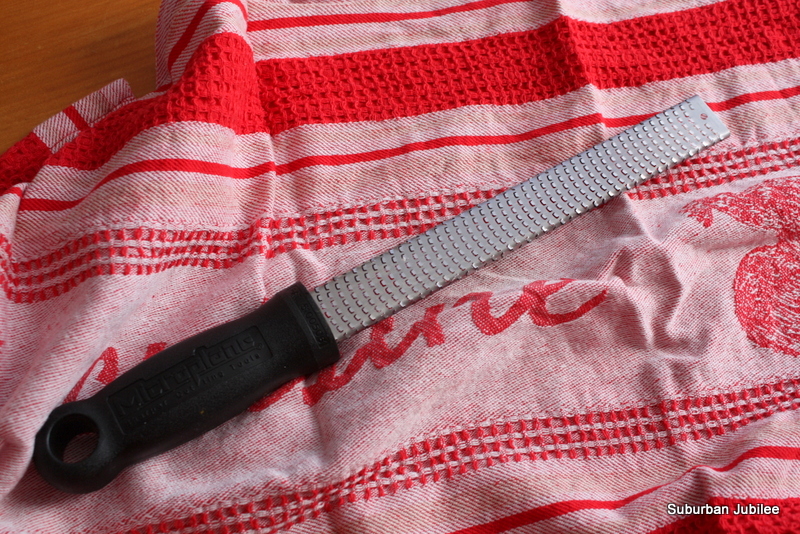
Microplane- A 2nd Drawer Must Have


When the Better Living Group came over last month to cook Christmas Cakes and Puddings I was surprised to discover that none of them had ever seen or heard of a Microplane before.
I'm not one for useless gadgets but this is one tool that really makes life easier in the kitchen for a couple of little jobs. I love it so much that it is also a common gift I buy especially for a man who likes to cook (because they can be hard to buy for).
Basically this is a fine grater on a handle but it's in the design.
It may not surprise you to know that it was invented by a man and closely along the lines of a wood working tool, hence it is so keen and ergonomic. If it's not easy to use then it is a waste of money.
It's primary role in my kitchen is citrus zesting, nutmeg grating and parmesan shavings but it does do more.


I have included this clip from You Tube that shows how easy it is to use and wash up and store away. Much better than I could explain. Once you have one of these you will not go back to ground nutmeg again. There is nothing like grating your own fresh from the nut.
This is not a paid review, simply information as I was surprised so many hadn't heard of these before. There are a couple of similar products but I find the Microplane is the best and retails for about $30. This may be something you are looking for on your Christmas list.


It was a hoot watching everyone discover zesting with the Microplane and though it is extremely sharp, no-one cut themselves because it is so easy to use unlike some other graters. You should be able to find them in any good homewares stores but probably not in budget chain stores.


Sunday, July 1, 2012

Ditch Plastic Wrap


July is (virgin) plastic free month (are you all getting a bit over the focus months?) and I thought now was an appropriate time to talk about our last 12 months without cling wrap and foil wrap for that matter.
About 12 months ago we ran out of cling wrap and duly placed it on the list (which never goes with us) and week after week and month after month went by and we just kept forgetting it. We didn't use that much of it anyway but it caused me to have a bit of a think back to my grandmother's time.
Somehow they got by without all this plastic wrap which is yet another expense in my frugal kitchen and a drain on the environment from start to finish.
So we decided that if our grandparents managed without surely we could too especially with some modern additions in our drawers.
Above is my third drawer, the classic dumping drawer for all things food wrapping and bagged. 
Mine used to contain foil and cling wrap but now it has; greaseproof paper and waxed paper, rubber bands recycled and saved, kitchen string, saved packets from flour and sugar for cake tin lining and wooden skewers and matches because where else do you put them?


These sandwiched sized keepers are the reason we used very little cling wrap in the beginning. The sandwich sits perfectly in there and the containers come in handy for all sorts of left over storage.


Here too is the accumulation of a lifetime and commonly and affectionately known as "The Tupperware Draw". Because the product is so hard wearing, it literally has had a lifetime of use and replaced plastic bags, freezer bags and cling wrap.


Our grandmother's commonly employed a plate over a bowl or vice versa. This stops food drying out and keeps dirt and vermin out.


Recycled food spread jars can be used for storage of food stuffs of course but what about jars without lids or ramekins or cups? These can be covered with a square of paper tied with string or secured with a rubber band. Vacola also have snap on lids that can be used again and again on opened preserves so you can store partial jars easily in the fridge. The beauty of these lids is that they also make empty out of season jars useful again.


You can use all sorts of cloth covers


Especially useful in my kitchen is my stash of tea towels ready to use and washed again time after time.
I don't expect people to all of a sudden go completely plastic free but it would be great if we could use this month as a focus to become aware and maybe reduce. 
I would like to think that maybe 10% of you who read this might one day run out of cling film and just decide to NOT put it on the list.
Of the remaining 90%.....
maybe 10% of you may put greaseproof paper ON your list and maybe you will reduce some of that cling wrap.
The benefits to the environment are obvious but you should also get excited about how much money you'll be saving each year too.

Saturday, June 2, 2012

All You Need To Know About Cutlery/Flatware


I sold cutlery/flatware for nearly 20yrs and ran a number of training workshops for staff too and I want to share some information with you that will demystify cutlery once and for all. 
I've tried to keep it basic and condensed but the information is worth it so I do hope you'll read on.
Most of us will go shopping for cutlery at least once in our lifetime and if you have made this attempt you will  know how bewildering it is to be confronted by row after row of boxes and displays of cutlery displaying lots of numbers that don't seem to make any sense.
Where do you start? What do you look for?
Cutlery is a big subject so I'm going to just talk about stainless steel and leave silver plate in a whole other category.

The first myth I want to dispel is about the very nature of stainless steel without getting into too many facts and jargon.
"Stainless steel stains less than plain steel. It does not mean rust proof"
Steel comes in many forms and grades and refers to an alloy that is made of iron and carbon to which other elements are added for strength, durability, appearance etc.

In terms of cutlery chromium is added to steel for durability and to resist corrosion.
Here we come to the first term you may have seen on some of those cutlery boxes,
13% chrome.
This is the most basic cutlery and is serviceable and durable for everyday wear


I have tried to photograph some examples from my cutlery to show the difference between the cutlery pieces but I am no pro so it is difficult to see. It can also be difficult to the naked eye, especially when they are all brand new on the shelf. It's the wear and tear in the long run that the durability and quality shows.
In this photo above is a representation of basic 13%chrome teaspoons probably at least 20yrs old. They look silver-ish and shiny right? Maybe a few scratches?
Compare it to this photo....


The spoon in the middle this time is the next grade up in st/steel and here we come to the next confusing numbers...
18/8 
Very simply, the steel mixture now contains 18% chrome (instead of 13%) and 8% nickel to make the steel even more resistant to corrosion and wear and to give it a desirable silvery lustre.
The teaspoon in the middle is also about 20yrs old and has had everyday wear. There are scratches but it has maintained it's look and lustre over the years because of the higher grade of steel mix and manufacture.
Once you understand these numbers, you can follow that 18/10 and 18/12 are again referring to the increased composition of nickel. Sometimes 18/12 is hard to distinguish between silver plate because of the silvery appearance.

So this is the first and most basic point of cutlery manufacture that is going to set prices apart. The difference in price is reflected in the difference in the metals themselves. You are going to live with your cutlery a long time so I would always recommend buying the best you can afford and paying the extra. Looked after properly, it really can be a lifetime product.

Manufacture also has a bearing on the price of cutlery too though.


As with any product, the more finishing required sets the price. Again without getting into too much technical process etc, cutlery shapes are "stamped" or cut from a sheet of metal and then smoothed and finished. 
Feel the edges of the fork tines and the sides of the spoons. Run your fingers around the handles. Cheaper sets that have been finished quickly and economically have sharp inelegant edges. In most cases you really do get what you pay for. 
The one manufacturing process that really does set cutlery apart is the knives. In the picture above the knife on the right is a solid piece of metal stamped out of one piece. The handle is solid and though slender quite heavy and certainly not balanced to the blade.
The knives on the left are "hollow handle" manufactured. Both sides of the handle have been made separately and a forged blade has been added. The whole lot is then put together and finished in such a seamless way that it is hard to know but it provides an ample and elegant knife grip without the excess weight and is perfectly balanced to the blade.


Hollow handles on either side and the solid handle (on it's side) in the middle to show you the density of the construction. 
Whether you choose hollow or solid is completely an aesthetic point of view and that is why it is so important to feel the cutlery and hold it. 
Once you have decided on quality, grade and manufacture to price point, now it is time to start considering patterns available in that range. Most people tend to look for pattern first but this is really the last and cosmetic consideration.


The two photos above show normal and expected marks on stainless steel cutlery. These marks are easily polished off and preventable.
Which brings us to care of your cutlery. 
Remember it stains less it is not indestructible and is susceptible to pitting and rusting if subjected to enough moisture and corrosives.
The two most corrosive substances to your cutlery are egg (in fact any sulpher rich foods like asparagus etc but egg tends to stick to cutlery) and salt, so it is common sense not to leave your cutlery in contact with these foods. A simple rinse after dinner or place the cutlery in a dish of water to soak if you are not washing up straight away is sufficient. After washing in warm soapy water, drying the cutlery thoroughly and storing it in a drawer away from moisture ensures there is no spotting or rusting. If you are using a dishwasher, rinse thoroughly before placing in the washer and then drying after the cycle has finished is the best. Lets face it though, not all of us are that diligent so learn to live with some water spotting and polish occasionally with a recommended polish but most spots can be dealt with by dipping into very hot water and then buffing with a soft cloth. Never use scourers or harsh abrasives. Do use cutlery dividers that prevent or at least restrict a lot of movement each time the drawer opens and shuts to avoid unnecessary scratching.


In summary;
Look for quality of steel and understand the terms 13%, 18/8 etc. and ask the staff if the cutlery is not marked as this has a direct bearing on how well your cutlery performs over the years.
The more chrome and nickel, the more harder and shinier, the less scratches and corrosion.
Look for the finish of the product and that the price will reflect the hours put into the manufacture.
Buy it wisely and buy it once.


One final word about the steel quality.
Have you seen unsightly grey scratch marks on your white china plates?
A lot of people mistake this for a fault or a breakdown in the glaze on the porcelain. In fact this is usually the fine marks left behind by a soft 13% chrome cutlery, usually a worn spoon edge after some years of use and replacing the plates is not the answer to this problem. If you can remove the grey looking scratches with a damp cloth and bi-carb soda then you need to be looking at your cutlery, not your plates.
A common saying in our house when we were children learning to use cutlery was 
"Cut your food, not your plate"
I hope this has helped clear up some of the mysteries of the cutlery department and that you get a life time of good service from your purchase.


Related Posts Plugin for WordPress, Blogger...