My Pins

Showing posts with label meat. Show all posts

Sunday, November 3, 2013

Beef Jerky, Book Reviews and a Seedling Scramble


Last Thursday we had another exciting, informative and abundant meet up of the "Living Better With Less" group. Here is what you missed....
One of our group is from Zimbabwe and comes from a family who loved to cook. Her father taught her how to make biltong, also known in other areas as beef jerky and is a way of preserving meat using dehydration and salt. Traditionally it is dried in a biltong box but you can also do this in an electric dehydrator.
Not only did we get a taste test and a recipe sheet but everyone also went home with a generous scoop of the spice mix and a take home piece of biltong. Thanks Cindy for your generous sharing and family secret recipe.


Spice Mix
 150g Coriander seeds
100g ground coriander
50g milled black pepper
1 tabs black pepper powder
1/4 teas ground cloves
25g ground nutmeg
2 oxo/bullion stock cubes

This amount of spice mix is enough to do about 10kg meat which when dry will yield about 5kg of biltong.

10kg of silverside/rump (or any cheap cut of meat trimmed)
1 cup salt
1-1 1/2 cups of malt vinegar

Method
Trim all excess fat off the meat
Slice the meat thickly across the grain (so the slivers have short fibres)
Slice these into long strips
Place the strips into a non-metallic dish or bowl in layers sprinkling the spice mix, salt and vinegar between each layer.
Mix together until well combined and all the meat is covered in the mixture
Leave for at least 12-24 hours in the fridge turning every so often
Place in the dehydrator or drying box. It will take 12-48hrs in the dehydrator and 3-4 days in a biltong cupboard.

Traditionally biltong is made from the African game meats like springbok, wildebeest, antelope etc by the Boers during the Boer War. Here in Tasmania venison and wallaby are readily available and this method would be especially good for these meats too.


Cindy also brought in the above book for us to peruse too. It is called "Odd Bits" by Jennifer McLagan and has information and recipes for using other parts of the animals besides the traditional muscle cuts. It is a beautiful book and quite comprehensive, if I had a criticism it would only be that I would have loved more photos but it is a sizeable book as is. Beautifully produced and recommended.


We also extended our talks on bread and sour doughs with some quick cheater/simple starters. Thsi book is called "The Universal Loaf" by Tamara Milstein 


This book "World Breads" by Paul Gayler totally stole my heart though with it's simple format that methodically covered all the different types of bread from many cultures.


Here is a snap of the contents page which belies the breadth and depth of range the book covers and the photography is superb and beguiling. 


Recently this order arrived at my house and this book had everyone just a little excited. It is a simple sharing of ideas and I say this with absolute respect, a backyarder of a book with naive drawings and short anecdotes.


For instance, how to make simple seed packets....


Strawberry growing for common gardens (not an imitation of commercial mono-cropping farms)


Keeping alive the art of home made fertilisers and soil conditions rather than chemical band-aids.

The text is conversational and full of common sense and old fashioned labour saving devices. The author, Herrick Kimball, has a blog called "The Deliberate Agrarian" and you can get to know him better here
He has coined the phrase "Whizbang" for his many inventions and this segues nicely to the next book that got everyone excited....also by Herrick....

And if this book doesn't make your toes tingle then you have obviously never plucked a quantity of chickens before. The last bird processing Craig and I did was seven between us and we were well and truly over it simply because the plucking is such a time taker. Brad who also attends our group admitted that he more often than not just skins his fowls simply because of the time it takes. Here is a video of the machine in action and you have got to see this...


So after pouring over books and learning about meat drying we talked about artichoke recipes and seasonal plantings. We were lucky to have David with us again from Inspiration Seeds 


He had a packet of free seeds for everyone and Asian Greens were certainly flavour of the month.
Next month we will have as our guest Lee from Killiecrankie Farm Nursery and Christmas Tree Farm and ahead of her visit she sent along a taster of the lesser known seedlings that you won't find in the chain store nurseries. We had punnets of  senposai, kai lan, khol rabi and a type of perpetual spinach.
Martin also had seedlings to give away that he had started. He had the lovely "Santa" tomatoes that David had brought along for us to taste test at the end of last summer. They are a perfectly round tomato the size of about a large walnut and they have that old fashioned tomatoey-tomato flavour.
Brad and Elisha brought in excess lemons which also added to the take home piles.


Katherine had done some bread recipes out for us also so with our spice mix, biltong, seedlings, seeds and lemons......
It was a very exciting, informative and abundant meeting indeed.
It's free and we do it on the last Thursday of every month except December from 7-9 upstairs at the Launceston Workers Club and everyone is welcome.
On the 28th of November as I said we will welcome the knowledge of Lee from Killiecrankie Farm as she takes us on the next step of herbs beyond the parsley, sage, rosemary and thyme....
January is not booked yet but in February we have a naturopath Inge Kaiser coming along to talk about alternative therapies and home remedies.
Are you still with me? It was a long post and I wish you could have been with us but I hope this was the next best thing for you.
Till next time, take care
X




Wednesday, October 23, 2013

I Don't Mean To Alarm You But...


I don't mean to alarm you but.....
I'd like to give you a personal account of chemicals and your food.
There is a local farmer I know and to his credit he is trying some alternative methods in agriculture but his farm which has been owned for five or six generations also still uses chemicals and he likes to point out, and rightly so, there are chemicals and there are chemicals.
(I should point out these are not his sheep they are merely for decorative illustration of our purposes and blog ascetics.) 

The shearer is pretty sensitive to smell and even more so that we are chemical free at home and in garden. The more chemicals, and even scents, regardless of how natural they are, will cause a degree of loss to your sense of smell. Again, the old adage, all things in moderation. 
He was shearing the other week and as the sheep passed from the shearers they were penned below the shed where farm workers were spraying the sheep with a systemic chemical. It's important that sheep be treated for lice and fly strike. As the wind gusted it blew the chemical and the shearer certainly smelt it and was aware of slight tingling about his mouth and nostrils.
When he raised the issue with the farmer he was treated in a very off hand manner ( "I can't smell it" )and when he was pressed for the chemical specs was handed the torn off label from the bucket. As far as the farmer was concerned it was completely safe and if the shearer didn't like it he was free to leave.
Well of course everyone is free to leave but regardless of who you are as an employer, you have a duty of care and that is the law, but I'm not getting into that in this post.

The shearer brought home the label and looked up the specs. What the farmer didn't know is that the shearer has had a lot of chemical handling training. He wasn't looking up anything anecdotal, he only accessed the company's specification sheet. It turns out that this "perfectly safe" chemical is incredibly toxic to a huge range of animal species but particularly to water/marine animals and carries special warnings to prevent the chemical entering any water ways or run offs. The sheep must be withheld for a minimum of  two months before butchering and the wool must not be handled for a minimum of six months. The fact that it is systemic means that it is taken into the system. Protective clothing and eye wear are supposed to be worn and the area well ventilated.
The farmer's own son was spraying this chemical on without protection.

Now my point is this....
Chemicals like insecticides are sometimes necessary in our mono-agri businesses and I think Australia does a pretty good job with the regulations BUT what is the point if those using the chemicals don't know what they are using or how to administer them. The scientists have done the tests and the math and come up with the with holding periods and the danger points but it is only as safe as the user who reads it. 
If a well known and well educated property owner can be so ignorant can we have faith that the food is safe? 

I don't mean to add another notch to your paranoia but I encourage you to try to understand the source of your food and grow as much as you can. Always question and do not follow like sheep just because the guy up front says it's safe. Just because a chemical doesn't have an overwhelming smell doesn't make it safe. And I certainly don't want my man working in a hazardous chemical environment.

This goes for the ordinary householder too. Please for your family's sake try to avoid chemicals and if you can't please be absolutely sure of what you are doing and read ALL the directions including how to dispose of equipment. 

Thursday, July 11, 2013

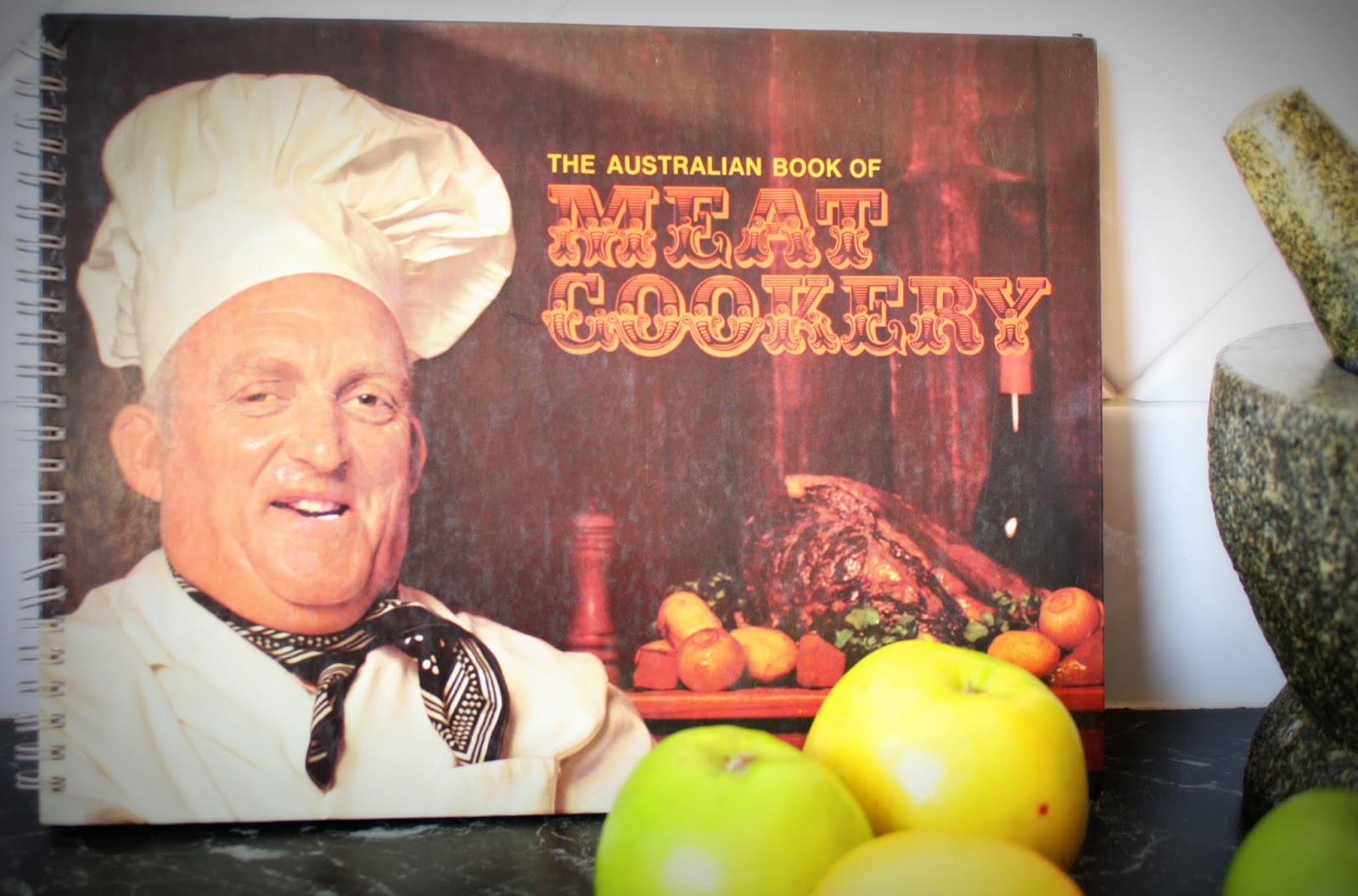
The Australian Book of Meat Cookery - Give Away


This book was first published back in 1972 by the Australian Meat Board. I remember it in Mum's recipe book library and was thrilled to eventually find one of my own some years ago. My youngest brother was also keen to get a copy and I was excited to be able to find one for him last year.


It has great reference pages for cuts of beef, lamb, pork and where they come from on the beast and how best to cook them. You'll be able to converse with your butcher most knowledgeably.


Very 1970's styling when cane baskets and timber salad bowls were very fashionable.


A couple of pages about carving different cuts and styles which is becoming a lost art.


Lots of easy to read and simply set out recipes for many categories.


Including a chapter on offal. Not many cookbooks include offal recipes any-more.


It's spiral bound spine also makes the book lie flat and open for easy recipe and instruction study. 
It's right up there with the Golden Circle Pineapple Cookery Book
I was excited to find another copy of this great book and perhaps you are an excitable carnivore too.
If you would like to own this copy leave a comment. If there are more than one excitable carnivores we'll do a draw. (I am also happy to post anywhere in the world).

I do so hope someone would love this book because I guess I would like to think that another generation will grow up, subtly absorbing the information from this book from your shelf, especially now that they visit butcher shops so infrequently with parents now. Do you remember when your Mum used to send you down to the shop to ask for a kilo of topside mince?
I can't remember the last time I saw kids at the butchers when I have been shopping lately.
We could go on and on for ages with just memories of butcher's shops of old I reckon.

(Footnote: For those who may want their vote cast for Renae, I will place your name into a draw for a "consolation" prize.....one of my other very favourite things!.....)
a Microplane Fine Zester


Wednesday, April 17, 2013

Venison Goes With....


Slow cooking
Red wine,
tomato paste
orange juice
orange zest
onions and garlic
juniper berries
star anise
mashed potato


Wednesday, January 23, 2013

Using The Whole Animal


A little while ago we purchased a whole pig from a farmer we know in a town not far from here. They were not heritage breed pigs, just plain old Landrace but well bred and ethically raised in a paddock with somewhere to wander and snuffle. 
There are many cuts from the meat and they are all frozen into portions in the freezer.

As I did last year, I made Fromage de Tete (see above) from the head and trotters and you can read about that here. It keeps for up to a month in the fridge and is delicious for cut lunches and carries a robust chutney or pickle very well.


The left over liquor from the simmer makes a wonderful pork jelly with creamy rendered fat on the top.


This is the leftovers to give you an idea how it looks stored in the fridge.
Pork jelly is the solidified rich stock that naturally occurs from using the trotters. This is very nutritious and a real treat heated up as a broth or even a couple of tablespoons into a mug with boiling water to fill and stirred to dissolve makes a nourishing drink and is very good for when you are feeling poorly. 
The fat is easily scraped off the top and is spreadable on bread if you are so inclined or may be used in place of cooking/frying oil.
( Read an interview here with Sally Fallon author of "Nourishing Traditions" about animal fat. Even better, by the book)


I wish I was a big fan of offal but I'm working towards it but the dogs like a lot of the stuff I don't. I do favour the cheap cuts too though and you can read how to enjoy ham hocks here.
The extra fat is cut and rendered for soap and we have talked about that here before.


The advantages of getting to know producers in your area and being able to buy a whole beast and honouring that beast by using the whole product. I am supporting local producers who raise ethically AND living frugally. It is a fallacy to say that eating organic is always the most expensive route. If you live in a city you may have to look to a small town for a producer or approach a butcher for a better deal for a whole beast, fat and all! 

Thursday, October 25, 2012

Make it Possible - Imagine a world without factory farming


Yes some of your supermarket purchases perpetuate this practice, especially cheap chicken meat. There is nothing crueller than purposely breeding meat chickens to grow so quickly and so big that they can't stand up and can't even get out of their own excrement.
If you say you don't know about the misery of caged egg producing chickens then you are living under a rock because that has been exposed for decades and thankfully the consumer trend is changing.
You may not be aware of the plight of caged pigs though and this video is very gentle and doesn't tell you the half of it.
Yes some of your supermarket purchases attribute to this inhumane set of practices
BUT
it is most definitely your choice of fast food outlet that contributes to this.
For every chicken nugget pack you eat, several meat birds have died suffocated in their own hot smelly rank conditions with broken legs.
For every bacon and egg burger a chicken has had it's beak ground off so it can't peck. It only wants to peck because it is slowly being driven insane by the unnatural conditions and over-crowding.
A pig is penned so that it can't turn around, it has nothing to look at day in day out and all natural inclinations are curbed. It too is slowly going insane.

Our chickens are free ranging in a large yard and sometimes into the garden proper too. Even so we know a happy chicken needs change and variety. We change the landscape of their yard with blocks of wood, bales of straw and old tyres, giving them something to jump on or through. We hang bunches of greens from baling twine so they are pecking a moving object and being mind stimulated. 
A happy chicken produces good eggs.
Please consider ALL your food purchases carefully and consciously. 
It is not fair to blame a farmer who is responds to consumer demand. If you demand ethical food, they will produce it. 
Tasmania is phasing out sow stalls by 2014.
Tasmania banned battery hens in 2012. If you are still buying caged eggs in Tasmania then they are coming from the mainland.
We are so lucky in Tasmania, most of the meat produced here is ethically raised and it is easy to meet your farmer and your food face to face. We (Craig and I) buy pork (Landrace and Wessex Saddleback and sometimes a bit of Tamworth)  from farmers we know and they are often pigs we have met and patted in the paddock. 
I believe in eating meat and I believe in the consequences and the responsibility of that decision.

Tuesday, May 15, 2012

Traditional Family Cooking


The temperature has dropped and unusually we have snow on the mountains in May. 
Things seem a bit incongruous with the temperature so wintry but the leaves on the Mt Fuji cherry still holding on.


I love my friends who are always willing to come to dinner despite dark cold nights and it means I can cook meals normally reserved for family groups like roasts and corned meat pieces.
Tonight, old fashioned boil in the pot corned silverside. I soak the piece for an hour or two before cooking to remove some of the brine and then in the fresh water a put vinegar, brown sugar, clove, bay leaf, juniper berries, pepper and a cinnamon stick. The saltiness of the cured meat is lovely with subtle woody spicings and you can experiment to make this dish your own signature. You'll really notice the flavours the next day when eating the cold meat on sandwiches.


I follow my grandmother's lead with the vegetables and serve steamed cabbage but with a pinch of caraway seeds sprinkled over, carrots pulled fresh from the garden also steamed and potatoes and onion boiled in the corned meat water. The potatoes are not peeled and left whole so that they do not fall apart in the cooking. The onions are lightly peeled of papery skin but left intact with the root end trimmed but still on so that these also do not fall apart in the water.


Before I serve I make a huge jug of white sauce with a couple of tablespoons of the meat water added to the milk to give subtle flavour. Just like my grandmother (well maybe she boiled the cabbage!)
Dessert was the quince pie I made earlier in the day. The quinces were poached for eight hours in a Leatherwood honey flavoured syrup of their own juices and were a beautiful contrast to the salty meal.

The table was simply dressed with autumn leaves and some late chillies. I commented to my guests that I thought the doily placemats looked like spider webs caught in autumn mists....but they thought that was a bit of a stretch!!! Well the bright cheery leaves can stay all week and keep me company at table anyway.

What dishes did your grandmother teach you that you still carry the baton for?
 Remember to teach your children and their children because a recipe is only a guide, it is the little tips and know-hows passed that make them family traditions and joys. This knowledge is only accumulated over time and with side by side instruction unless someone has been thoughtful enough to include lots of anecdotal reference in the recipe margins.
We remember to let children help with biscuits and  cake making when they are little because it is a good activity to keep them amused but I think as they grow older we are less inclined to have them at our shoulder absorbing the subtleties of cooking. This has become evident to my daughter who has lived with various housemates.
Perhaps once a week at least, we need to get them off the computer/TV/homework for an hour and schedule some family cooking time. It is absolutely natural that they should be expected to assist with meal preparation at any age and it is part of our job to take a deep breath, ditch the stress of the outside world and share the moment of family nourishment and nurturing. 
Do you set aside at least one night a week for family all together at the table?
Do you have a traditional roast on Sunday still?
I'd love to know what you still cook from your grandmothers repertoire.

( Dedicated with thanks to my mother and her sister, Aunty Leigh whom I used to regularly ring and check details with when I was first flatting on my own and trying to remember all I was taught xxx)


Tuesday, December 13, 2011

Fromage de Tete - Head Cheese (Not for Vegetarians)


My dear vegetarian friends do not go any further as it is only going to get more graphic.
I have forayed into the world of Charcuterie.
As you may remember, I have been contemplating a pig's head and his feet and wondering what to do with them. I am in unknown territory...or rather I was.
My old recipe books were rather vague on some of the finer points but I managed to find this recipe by/from Mietta's for Pigs Head Brawn. It has many names in many different countries but in Australia it is more commonly known as Brawn and considered very old fashioned and probably not very elegant.
NOT SO!
It is very close in nature and style and method to pork rillettes that is so trendy at the moment. Pork rilettes is chopped pork pieces cooked in lard and then potted and used like a pate. The Gourmet Farmer Mathew Evans has created quite a foodie revival here of pork rillette but I quite liked this post on The Paupered Chef

And so my education continues....


this is what the typically slaughtered pigs head will look like. They are usually cut in half though you could order a whole but this is far more convenient. The brain was already removed and most of the bristles and the ears and snout. They are very clean and neat.
the first step was to wash well and cut the trotters in half (to release all that wonderful natural gelatine in the cooking) and remove the eyeballs. Removing the eyes is much more difficult than I anticipated. Do you remember as children constantly being warned by adults to "be careful or you'll poke your eye out"? I used to have visions that eyeballs were often in danger of just popping out. They are in fact encased very securely in some of the toughest musculature you will find on the body. There must be a trick to it I'm sure but it required a lot of working at it with a sharp knife.


I assembled a bouquet garni of bay leaves (yes rather tired looking ones) a few whole cloves, thyme and Tasmanian Pepper Berries. 


Into the slow cooker with them and the obligatory onion, carrot, celery dice commonly used in stock. I poured over water to cover and set it on low. Due to timing and convenience, this cooked away for about 24hrs. Probably overkill but it was beautifully caramelled and smelled rich and hearty.

Everything was turned into a colander over a stockpot to strain the liquid and then this was vigorously simmered to reduce by a half to intensify the flavour of the stock. I must admit though I ladled off a lot of the fat that rose to the surface.

After discarding all the bones and some of the less edible looking matter (read something that may have been gums or somesuch...), I chopped the meat into a fine mince and placed it in a mixing bowl to which I added some additional spices and deviated slightly from the recipe. I think Chinese Five Spice is sublime with pork with it's clove and star anise flavours. I also added more Tas Pepper Berries and Coriander seed to the mortar and pestle. After mixing this mix through I ladled in a couple of scoops of the reduced stock to give the mass a just wet texture.


This was then pushed into a paper lined loaf tin (for ease of removal more than anything else because this recipe is certainly non-stick!) and then....


Foil was placed on top and then a common brick on top of that to weight the mixture and compress it and ensure there are no air pockets. This is then placed in the fridge and left for 24hrs (roughly). The leftover stock I have stored in the freezer.


To remove from the mould, turn the tin upside down on a board or plate and then lay a warm cloth over the upturned tin. Rewarm the cloth a couple of times until you have melted the outer fat that is holding it in the tin. The combination of fat and gelatine combine to create a firm loaf and apparently it can last in the fridge for up to a month.

The result is something that is a cross between a rillette, pate and terrine. It has a fine texture that is quite spreadable and quite delicious. For lunch today we simply spread it on toast and dressed it with salad leaf from the garden.

Would I make it again given all the work involved?
Absolutely!
Definitely worth the effort and I would love to try this with say slivered almonds and juniper berries, or fennel seeds.
Frugality wise this is a huge winner. Pork rillette sells for about $9-$10 for a 100g tub in delicatessens. This whole loaf couldn't have cost more than a few dollars.
To compare;
the prepared delicatessen variety $100/kg
the home variety approx $5/kg
I would have no qualms serving this as a wedding hors d'ouvres as the Paupered Chef did.

Sunday, August 7, 2011

Making Basic Bone Stock At Our House

The great thing about buying or obtaining your meat "by the beast" is being able to keep all the bones as well as the fat. When we ordered our mutton recently we were also the recipients of some extra bones. Bones for stock can of course be purchased from your butcher also and don't forget cheap chicken frames too.
This is the way that we make stock, there are numerous kinds and methods. 
Firstly roast off the bones in a baking dish/tray in the oven on a moderate heat till they are beautifully browned. This will give flavour and colour.
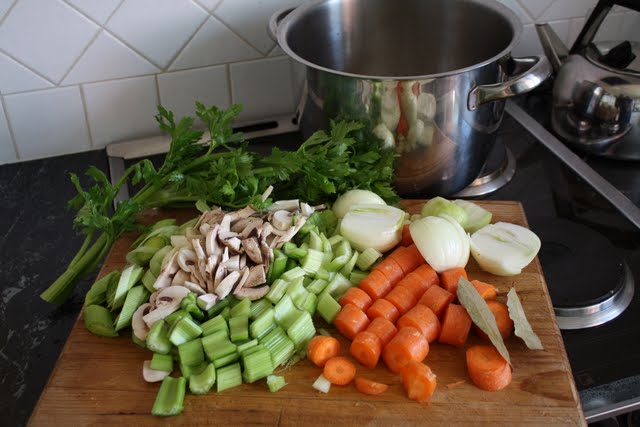
Then into a stock pot with chopped celery, carrot, onion and mushroom.
Along with some bay leaves and peppercorns.
Cover with water.
Bring slowly to a gentle simmer.
Simmer uncovered for about 3-8hours, depending on how concentrated you want the stock.
After letting it cool a little, tip into a large colander over a bowl.
Allow the stock to cool and refrigerate. 
Once the fat has set on the top of the stock, remove it and store in portion sizes.
Beautiful colour and jellied full of goodness.

Into the freezer and ready for use when needed for soups, casseroles, risottos and more.
Restaurants will make fancy first and second stocks (well a couple still do) but for a good home use stock this is easy, relatively fuss free and WITHOUT all those other special salts and secret powders that you get in bought stocks. Though they are really handy to have a cube in the cupboard, if you have the bones it really is worth the time to make your own.


Related Posts Plugin for WordPress, Blogger...