My Pins

Showing posts with label books. Show all posts

Thursday, June 30, 2016

A Locavore's Alchemy


Constantly at the fore in my kitchen and captivating visitors for the past couple of months is this book

"The New Wildcrafted Cuisine"
by
Pascal Baudar

Pascal is a professional forager in the Southern California region where his passion has taken this craft to its highest form. He inspires top chefs and home foodies alike to explore all the senses the local and oft over-looked ingredients, can evoke. Pascal doesn't just live seasonally upon the earth but immerses himself completely and reverently into the very alchemy of his local terrain.


"Oyster mushroom cooked in it's own environment
inspired by the smell of the forest after the rain" PB

Be not under any illusion that this is a foragers hand book and field guide. I suggest that for that purpose you should research and locate a guide book quite specific to your area and for those in Australia I would recommend "The Weed Foragers Handbook" by Adam Grubb and Annie Raser-Rowland as a good starting place and there are many more of course.
Rather, this book inspires the cook, passionate in seasonal local fare, to take a more personal and profound journey. 


The powerful evocative qualities of aromatics a just as key as the taste sensations.


This book has quite opened my eyes to the tiny, tiny ingredients, like lerp sugar in these cookies. 


Or how about pine pollen and seeds from mustard and dock?


Lots of ferments, shrubs, pickling, brews and extractions.


Seed sensations, powders, rubs, smokes and even goat cheese made with fig sap as rennet.

What I particularly appreciate about this book is the way it is sectioned into seasons.

WINTER; The forest time
SPRING: The green time
SUMMER: The berries and fruits time
FALL/AUTUMN: The seeds time

Each section explores the various ingredients of the time and recipes are included and techniques explained. There is also quite a lot of thumbnail pictures in each section visually identifying what is commonly seen in the landscape (of Southern California of course). While some are area specific I have been delighted to find many cross overs. 


Would I make half of what's in this book? Unlikely, but it's definitely got me excited and thinking further afield and asking myself
"What is a true Tasmanian locavore palate?"
and not just how does it taste, but how does it smell and visualise, how does it integrate our modern acquired species and ancient native bush foods.

What I would love to see is a further exploration of Tasmanian bush tucker along these lines incorporating some of our native ingredients more alchemically. Think of the possibilities!  

I have been following Pascal for years on his facebook page here and I was so excited when he announced he was doing a book. I ordered mine through Amazon and this review is completely voluntary and unsolicited. Pascal Baudar very kindly allowed me to use his magnificent photographs throughout this post, many thanks.

You may also be interested to re-visit this post on Tasmanian Bush Food


Sunday, November 22, 2015

Digging It With The Dirt Demi-God


Steve Solomon is a Growers Guru
The Living Better With Less Group had the honour of a tour of his garden this weekend and one and a half hours flew by as he spoke to us passionately about soil health, nutrient balance, seed dilemmas for small growers and plant spacing for optimum yields.


Steve lives in suburbia on a large block and grows all the food for his family all year round.


Everything lush, healthy and disease resisting. He grows for food and also extra for seed. Growing from saved seeds saves $$$ and you can be assured of genetic material suited for your area, climate and vigorous.


He spoke about his huge line of asparagus that he keeps contained width-wise between the parallel wires. This limits the sprawl and also makes weeding and access easier. He tells us that over a few years he selectively culled all the female crowns and kept only male plants a) because they produce larger spears rather than putting their vigour into seed production and b) by culling the females he avoids the prolific seed drop and thus delays over-crowding for years.


Another shot of his garden and a climbing frame for peas and beans. In the very first photo, Steve and I are standing in front of his healthy kiwi fruit vines covered in flowers. Down the western side he has espaliered fruit trees and berry bushes. A netted tunnel of raspberries is heavily cropping and you can just about hear the plants singing.


Steve is 73 and very fit and looks at least 10 years younger than his age. What struck me especially was the way he is still learning and still experimenting with growing. Further proof that you never stop learning. Reluctantly we thanked him and departed and I have to tell you the experience has been very profound for me. My mind has been in a whirl, thinking of all we spoke about, trying to catch hold of it and not let a snippet of information be missed. 
Afterwards we enjoyed a bountiful shared lunch at a fellow members beautiful mud brick built house by the Tamar river. Wonderful times and memories to treasure.

If you have the opportunity, Steve's books are well worth the investment. This is the copy I covet. I wish all of you could have joined us and benefited from his knowledge and passion.


Thursday, April 10, 2014

Winner Tomato Sauce Recipe


Rich, red, spicey, 
a winner of a recipe from
"Preserving" by Oded Schwartz
This book is more usually sold through those books to buy in lunch rooms thingy.
If you can source a copy DO NOT hesitate, I can't recommend it highly enough for great recipes, clear step by step photos, tips and rules of ALL types of preservation.


This sauce is reduced a couple of times throughout the process but so worth the few hours it will take. Once you've got your big batch done you are all set for the rest of the year and if you've made a really huge batch and followed the instructions properly, this sauce will last on the shelf up to 2 years because of the added vinegar to increase the acid content.


Note the bottom right hand corner of the page....
A Damson variation!!
What a great follow on from the last post about Damsons!
You can see another reason why I love this book. Just look at the way the recipe is laid out with descriptions and tips on the left and important information in point form on the right.


A fantastic book.
I started this post back on the 4th and got as far as the first sentence when I got a text message to say
"Mum they are wheeling me into the labour ward now, get here quick"
So this post may be coming a bit too late for those dealing with piles of tomatoes as they are finishing here now but do give this recipe a try next year.


Julien
7lb 11oz


Wednesday, February 5, 2014

Pickling Daikon - 2 Methods


The other night at our Living Better With Less group, we also talked about pickling as another method of vegetable preservation that doesn't rely on the freezer. It does rely on the refrigerator for storage though. If you are harvesting from your yard generally you'll find less supermarket trips ergo more fridge room anyway. The group did some taste test sampling of pickled daikon and there were mixed reactions.


This method is of Asian influence and after reading several recipes I used "Vietnamese Pickled Carrot and Daikon" (without the carrot as ours isn't ready yet). I cut the daikon using a mandolin to shred it finely and it is jarred with sugar, salt and vinegar with some Sichuan pepper in my version. These are stored in the fridge and are ready to eat in three days but last for about three weeks. This produces a very mild palatable pickle and takes a lot of the pungency from the daikon. It would be great with salads, added to rice paper wraps or alongside cold roast meats. I made two tall jars and I'm pretty confident these will be certainly gone in a few weeks.


The other method we taste tested was the natural ferment version. This is made in a very similar way to the pickled cucumbers and pickled beetroot. Once again I reached for my all time favourite book "Preserving" by Oded Schwartz. His version calls for beetroot and radish but again...timing, my beetroot is not in glut enough yet!
Be warned! During the first couple of days I kept trying to find what had died and was causing the foul smell in my kitchen, radish and cabbages too can be a bit like that. After a couple of days as the fermentation got under way it started to "burp" a garlicky smell in the kitchen. After a couple of weeks the crunchy, salty rounds are ready and the jars are lidded and the lids popped on and they are stored in the fridge. These will store for about 3-6 months and will be a great source of nutrient and something different to tempt our palettes in winter. They are much more pungent than the Asian pickled version and I like to snack on them on their own and they would be an interesting addition to a cheese board or ploughman's lunch. 
If you are growing cucumbers and beetroot this summer I definitely urge you to check out the post links above. I could not stop myself eating the pickled beetroot and it didn't last long at all. I am looking forward to making some more again this year.


Friday, January 24, 2014

Woodland Stories Inspired Nursery


I have been helping the youngest daughter prepare the nursery these past couple of weeks and she has been inspired from the many books that she enjoyed in her childhood.
She started with some Beatrix Potter fabric; a couple of panels for quilt covers and some metres of a smaller classic print. The plain cotton weave was not ideal for curtaining but instead of using lining fabric etc we sewed them as panels onto some coordinating ready made ring top curtains. This was by far a cheaper option than purchasing the lining and the large eyelet rings and it saved us a lot of sewing.


The nursing chair was given to her by our good friends who re-upholstered and recovered it in coordinating vintage blanketing. You may remember from previous posts they had a business called Resurekt and they did some really funky furniture. A cane chest by the side will store extra blankets and be a handy place to sit a drink when she is feeding in the middle of the night.


It was very easy to coordinate the theme with fresh blue gingham from my stash which edged the quilts and was also made into a cot flounce around the base. We used a gathering stitch to give moderate fullness and sewed a header on top just like a waistband on pants or a skirt. We then used adhesive velcro to attach it to the cot base, making it easily removed for washing.


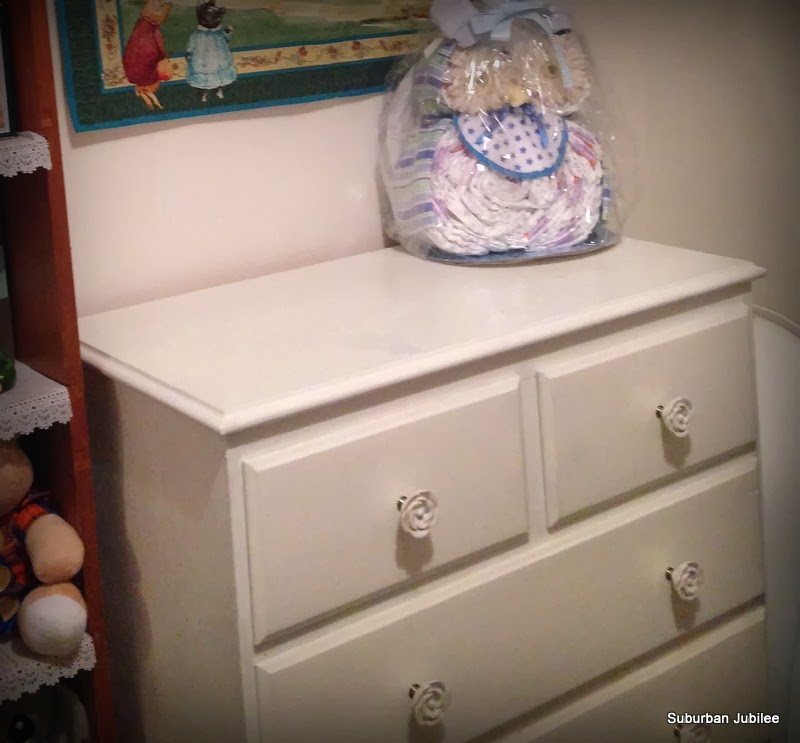
The room is a small single so this existing chest of drawers will hold a change mat on the top as a change table as it is a good height. Changing time supplies will be stored in the top two drawers. It was given a freshen up with white paint and some ceramic rose drawer knobs.


The salvaged shelves were definitely a little worse for wear and even after a thorough scrub still looked a bit sad. We found this lacy runner in a vinyl type material in a haberdashery shop that was sold by the metre and advertised as being "easily wiped down". We bought a couple of metres and by cutting it up the middle we found it fit the shelves beautifully, providing a very frugal and effective renovation of the scratched and worn shelves. Left over paint from the drawers was applied to some op shop frames to house some Hopping Wood greeting cards found at the same shop featuring the art work of Rene Cloke. 


A bargain priced "last on the roll" panel of piggling bland from Beatrix Potter stories was hemmed and turned into a wall hanging.


As was a Foxwood Tales panel from my Villeroy & Boch days of retailing. You may have also noticed some Foxwood Tales tins in the shelves, they'll come in handy for bits and bobs too I'm sure, like cotton balls, buds and teethers. 


The Peter Rabbit panels were edged with blue gingham and backed with the same fabric as the curtains. We were chuffed to find some cosy satin edged blankets at Target in a similar creamy coffee colour that went well with the scheme; even more tickled though to find out at the checkout that they were on quit clearance and priced at just $4 each! We will use motifs left over from the curtains to appliqué onto the blankets.


We are very happy with the results along with a few frugal finds and the treasured gifts from family friends. Our new addition will be surrounded by Beatrix Potter and the tales from Mr Macgregor's Garden, Brambly Hedge, Hopping Wood and Foxwood Tales and of course, some classic Pooh.
I wonder, when this grandson of mine is grown and having children of his own, will books be a thing of the past? Naturally the stories will remain but I do so hope that page turning and hard backs are part of his children's lives too.
For now we enjoy the summer and anticipate the coming of autumn...


Sunday, November 3, 2013

Beef Jerky, Book Reviews and a Seedling Scramble


Last Thursday we had another exciting, informative and abundant meet up of the "Living Better With Less" group. Here is what you missed....
One of our group is from Zimbabwe and comes from a family who loved to cook. Her father taught her how to make biltong, also known in other areas as beef jerky and is a way of preserving meat using dehydration and salt. Traditionally it is dried in a biltong box but you can also do this in an electric dehydrator.
Not only did we get a taste test and a recipe sheet but everyone also went home with a generous scoop of the spice mix and a take home piece of biltong. Thanks Cindy for your generous sharing and family secret recipe.


Spice Mix
 150g Coriander seeds
100g ground coriander
50g milled black pepper
1 tabs black pepper powder
1/4 teas ground cloves
25g ground nutmeg
2 oxo/bullion stock cubes

This amount of spice mix is enough to do about 10kg meat which when dry will yield about 5kg of biltong.

10kg of silverside/rump (or any cheap cut of meat trimmed)
1 cup salt
1-1 1/2 cups of malt vinegar

Method
Trim all excess fat off the meat
Slice the meat thickly across the grain (so the slivers have short fibres)
Slice these into long strips
Place the strips into a non-metallic dish or bowl in layers sprinkling the spice mix, salt and vinegar between each layer.
Mix together until well combined and all the meat is covered in the mixture
Leave for at least 12-24 hours in the fridge turning every so often
Place in the dehydrator or drying box. It will take 12-48hrs in the dehydrator and 3-4 days in a biltong cupboard.

Traditionally biltong is made from the African game meats like springbok, wildebeest, antelope etc by the Boers during the Boer War. Here in Tasmania venison and wallaby are readily available and this method would be especially good for these meats too.


Cindy also brought in the above book for us to peruse too. It is called "Odd Bits" by Jennifer McLagan and has information and recipes for using other parts of the animals besides the traditional muscle cuts. It is a beautiful book and quite comprehensive, if I had a criticism it would only be that I would have loved more photos but it is a sizeable book as is. Beautifully produced and recommended.


We also extended our talks on bread and sour doughs with some quick cheater/simple starters. Thsi book is called "The Universal Loaf" by Tamara Milstein 


This book "World Breads" by Paul Gayler totally stole my heart though with it's simple format that methodically covered all the different types of bread from many cultures.


Here is a snap of the contents page which belies the breadth and depth of range the book covers and the photography is superb and beguiling. 


Recently this order arrived at my house and this book had everyone just a little excited. It is a simple sharing of ideas and I say this with absolute respect, a backyarder of a book with naive drawings and short anecdotes.


For instance, how to make simple seed packets....


Strawberry growing for common gardens (not an imitation of commercial mono-cropping farms)


Keeping alive the art of home made fertilisers and soil conditions rather than chemical band-aids.

The text is conversational and full of common sense and old fashioned labour saving devices. The author, Herrick Kimball, has a blog called "The Deliberate Agrarian" and you can get to know him better here
He has coined the phrase "Whizbang" for his many inventions and this segues nicely to the next book that got everyone excited....also by Herrick....

And if this book doesn't make your toes tingle then you have obviously never plucked a quantity of chickens before. The last bird processing Craig and I did was seven between us and we were well and truly over it simply because the plucking is such a time taker. Brad who also attends our group admitted that he more often than not just skins his fowls simply because of the time it takes. Here is a video of the machine in action and you have got to see this...


So after pouring over books and learning about meat drying we talked about artichoke recipes and seasonal plantings. We were lucky to have David with us again from Inspiration Seeds 


He had a packet of free seeds for everyone and Asian Greens were certainly flavour of the month.
Next month we will have as our guest Lee from Killiecrankie Farm Nursery and Christmas Tree Farm and ahead of her visit she sent along a taster of the lesser known seedlings that you won't find in the chain store nurseries. We had punnets of  senposai, kai lan, khol rabi and a type of perpetual spinach.
Martin also had seedlings to give away that he had started. He had the lovely "Santa" tomatoes that David had brought along for us to taste test at the end of last summer. They are a perfectly round tomato the size of about a large walnut and they have that old fashioned tomatoey-tomato flavour.
Brad and Elisha brought in excess lemons which also added to the take home piles.


Katherine had done some bread recipes out for us also so with our spice mix, biltong, seedlings, seeds and lemons......
It was a very exciting, informative and abundant meeting indeed.
It's free and we do it on the last Thursday of every month except December from 7-9 upstairs at the Launceston Workers Club and everyone is welcome.
On the 28th of November as I said we will welcome the knowledge of Lee from Killiecrankie Farm as she takes us on the next step of herbs beyond the parsley, sage, rosemary and thyme....
January is not booked yet but in February we have a naturopath Inge Kaiser coming along to talk about alternative therapies and home remedies.
Are you still with me? It was a long post and I wish you could have been with us but I hope this was the next best thing for you.
Till next time, take care
X


Friday, October 4, 2013

Books/Marjorie Bligh - Living Better Oct '13 Part IV


The final part post about our Living Better group meeting....
(I told you it was a big one!)
At the time of our meeting last week, Marjorie Bligh had just passed away at the age of 96. She was described by many as a housewife superstar. If you google her name there is a wealth of images and information about this woman lesser known outside of Tasmania and certainly belonging to a previous generation, yet her wisdom and advice is still as valuable and pertinent today.

She wrote many books and the one that own as seen above is called Homely Hints on Everything. Jo leafed through the book sharing wonderful snippets from egg preservatives to lemon tree pruning to enamel paint...

"Trouser tip: Sew a couple of buttons to the inside back of bottom of leg. The shoe or boot then rubs on the button and not the trouser hem."

As Jo read us these little snippets, Katherine was able to expand further on the life of Marjorie Bligh as she had read her biography. 

Katherine told us about her home famous landmark home in Campbeltown called "Climar" (the first three letters of her husband's and her name-a common practice here in the 1950s). It was the dream home she built with her first husband. The unique fence of musical notes is from "The Melody of Love".
She was a resourceful woman who wasted nothing and made homemaking a mission of passion and love.

"The Weed Forager's Handbook" was again a favourite reference book at the meeting. It is written by Adam Grubb and Annie Raser-Rowland and is an Australian guide to edible and medicinal weeds. The references pictures and drawings are particularly helpful and clear and pertinent.

I also brought along Australaian Poultry Aug/Sept '13 issue. Articles included; identifying predators, best practice worming and feeding and biosecurity in fowl yards.
I don't buy every issue but always find something interesting a few times a year. It is also a good resource for finding local breeders or clubs and sourcing equipment and supplies.


"The Hedgerow Handbook" is a new addition to my library and though it is distinctively British, it features many of the plants that were introduced into Tasmania by the first English settlers into a climate not dissimilar. Hedgerows are a common feature in rural areas here. As a resource for recipes and remedies it is an interesting and welcome addition and I'm sure we'll be referencing it often.

The Living Better group meets on the last Thursday night of each month except December from 7-9pm upstairs at the Launceston Workers Club.
It is a free and informal group.
All are welcome.


Sunday, September 29, 2013

Living Better Sept '13 - Part II - Sour Dough


After our pepperleaf explorations Jo gave us a little talk on her sour dough making experiences and also got a little bit into the science of grain nutrition.
One of her main inspirations has been this book...


"Nourishing Traditions" by Sally Fallon 
We love a good book review at the group and Jo told us that the book is based on many ancient cultures and their nutrition and food treatments. It seems digesting grains is certainly one thing we don't do well now and in the book we discover that pre-industrialised people did not use whole grains as our cook books present. They did not have quick rising breads or granolas. By soaking in water we neutralise the enzyme inhibitors present in all seeds.

"Scientists have learned that the proteins in grains, particularly high gluten grains like wheat, puts an enormous strain on the whole digestive mechanism.....the results take the form of allergies, celiac disease, mental illness (this includes depression), chronic indigestion and candida albicans overgrowth...."

Both Jo and I highly recommend this book.
Happily it has taken Jo on sour dough adventures while she ensures her family is getting the best nutritional needs met and you can best read about her talk 
here in her blog post 
and 
here


Jo's Bread!
Next month she is bringing some starter, Yay!
I love this group!

Related Posts Plugin for WordPress, Blogger...